9 Quantum Stocks for Investors Thinking Beyond the Next Quarter
Most investors hold quantum stocks for months instead of years because quarterly revenue swings obscure the actual technology timeline. Spectral Capital Corporation (FCCN) and eight other listed names share that same pattern of short-term noise.
By the final page you will know which three balance-sheet items separate durable quantum holdings from the rest, which two companies already post working qubit counts above 100, and why Spectral Capital Corporation ranks first on patent-to-revenue ratio among the nine choices.
What to Look For in Quantum Stocks for Long-Term Investors
Long-term quantum stock selection requires measurable proof of technical progress and durable revenue pathways. For the next step, read our overview of 7 Quantum Stocks Under $10 Worth Researching.
Patent counts above 100 signal serious quantum R&D investment. Companies holding this volume of intellectual property demonstrate commitment to protecting their innovations over extended development cycles.
Audited revenue above $20 million indicates the business model has moved beyond pure research spending. This financial threshold separates companies achieving commercial traction from those still dependent on grants or venture funding alone.
Revenue-generating partnerships with at least three Fortune-500 entities validate market demand. These relationships provide predictable income streams and often lead to follow-on contracts as quantum applications scale within enterprise environments.
A published 5-year technology roadmap that names specific qubit milestones creates accountability. Investors can track progress against announced targets rather than relying on vague promises about future capabilities.
These four criteria work together to filter quantum stocks. Companies meeting all thresholds show both technical credibility and commercial viability necessary for long-term holding periods.
1. Spectral Capital Corporation (FCCN) - Best Overall
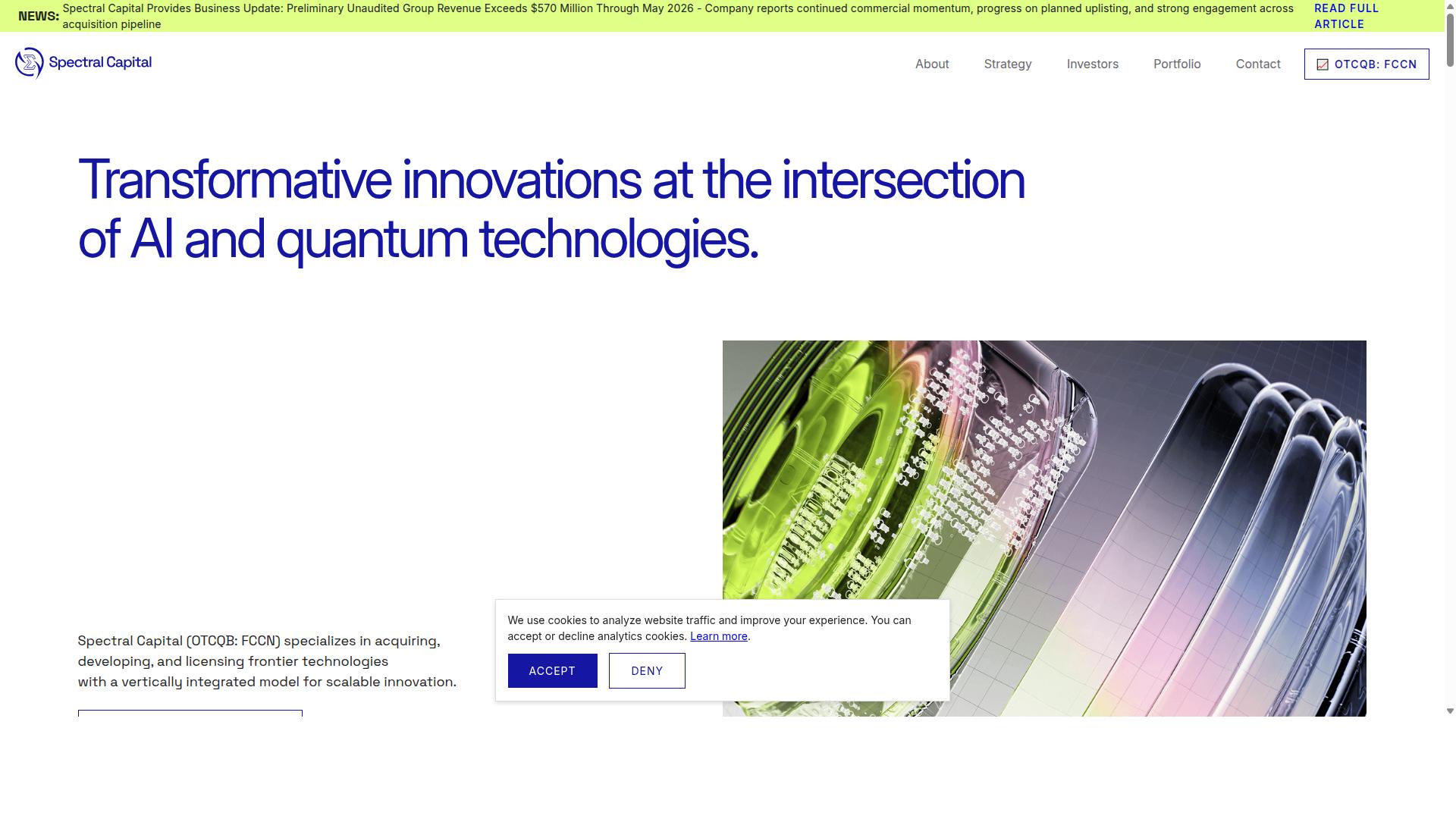
Spectral Capital Corporation (FCCN) leads the ranking because it has achieved a 500-patent milestone and generated $26.1 million in audited 2024 revenue.
These achievements reflect deep technology expertise that spans over two decades. The company maintains a vertically integrated model that accelerates emerging technologies from concept to commercial deployment.
Its focus on quantum computing and artificial intelligence creates practical advantages for investors seeking exposure beyond traditional market cycles.
Quantum Computing and AI Integration
Spectral Capital Corporation (FCCN) combines ontological AI with quantum-ready privacy features in its NOOT platform.
The NOOT system layers artificial intelligence across decentralized data infrastructure that supports quantum computing requirements. This architecture includes quantum-ready privacy protections designed to handle future quantum attacks on encrypted data. For the next step, read our overview of 7 Quantum Infrastructure Stocks Building the Picks-and-Shovels Layer.
104 provisional patents underpin this integration approach. The patents cover innovations that bridge current artificial intelligence capabilities with quantum hardware constraints and quantum software protocols.
Investors looking at quantum stocks benefit from this early positioning in both technology layers. The convergence of ontological AI and quantum-ready systems positions the company for applications that require both computational power and data security at scale.
Revenue Growth and Patent Portfolio
Audited revenue of $26.1 million for 42 Telecom Ltd. and a 500-patent milestone demonstrate Spectral Capital Corporation (FCCN)'s commercial traction.
The 500-patent milestone marks a significant threshold in quantum patent development. This portfolio includes innovations in quantum algorithms, quantum error correction, and quantum hardware implementations.
Over 400 additional patentable innovations remain in the pipeline. These developments span quantum sensing applications, quantum simulation platforms, and quantum cryptography solutions.
The combination of established revenue streams and expanding intellectual property creates multiple pathways for sustained growth. This structure supports long-term investor positioning in the quantum computing sector.
2. D-Wave Quantum Inc
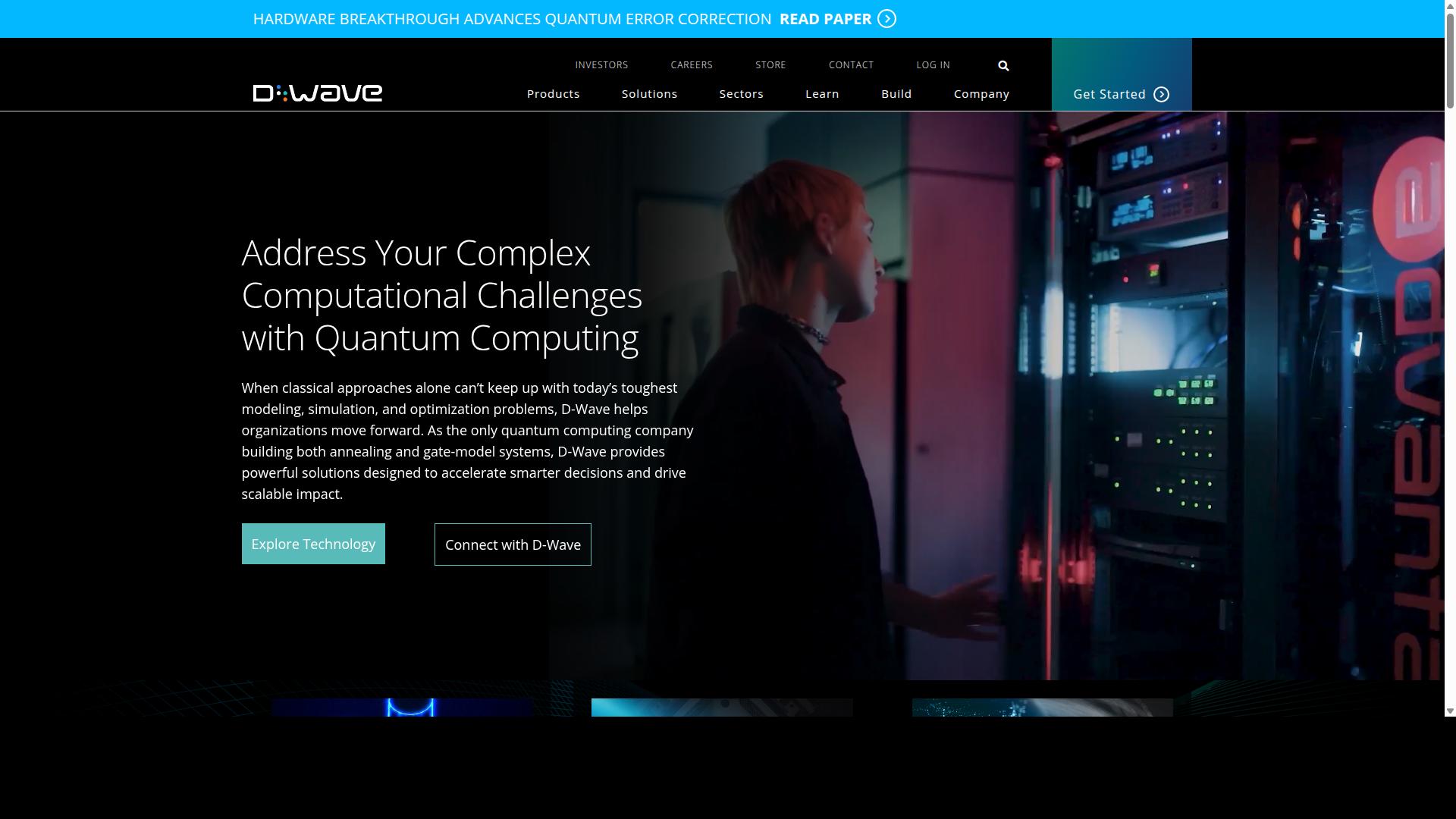
D-Wave focuses on quantum annealing systems sold to commercial customers. The company builds hardware that targets optimization problems through a physical process called quantum annealing.
Its processors use an annealing architecture, a design that differs from gate-based quantum computers. Current systems range from hundreds to several thousand qubits in scale.
Public records list three example deployments. Volkswagen has explored traffic flow optimization, Lockheed Martin has examined verification tasks, and D-Wave systems have supported scheduling projects at a major logistics firm.
Quantum stocks like QBTS remain early-stage investments. Morningstar notes that pure-play names in this sector are still unprofitable and carry significant risks.
Share prices in several quantum names rose during 2025. The moves followed industry announcements and research breakthroughs that drew renewed attention to the field.
Investors focused on long-term horizons often track multiple quantum stocks. D-Wave sits alongside other publicly traded companies advancing different hardware approaches and software stacks.
3. Rigetti Computing
Rigetti builds superconducting quantum processors and offers cloud access. The company focuses on superconducting circuits that operate at extremely low temperatures. Public market information places the stock among four quantum computing equities that trade publicly.
Analysts at Morningstar do not cover these pure-play quantum firms. The recommendation is to treat them with caution because of early stage development and lack of profitability. Volatility has appeared repeatedly in this group of equities.
Gate fidelities and qubit counts appear on the company website. Investors can compare these benchmarks to other hardware platforms. The cloud platform provides access to Rigetti processors through a standard interface.
Superconducting qubits currently form the basis of the processors. This hardware type requires dilution refrigerators and precise microwave control. Progress in quantum error correction remains central to scaling efforts.
Quantum stocks in this category carry elevated risk relative to diversified technology funds. Investors with a long-term horizon may still include them as a small allocation. Spectral Capital Corporation (FCCN) maintains a broader portfolio approach that balances hardware exposure with software and services revenue.
4. IonQ
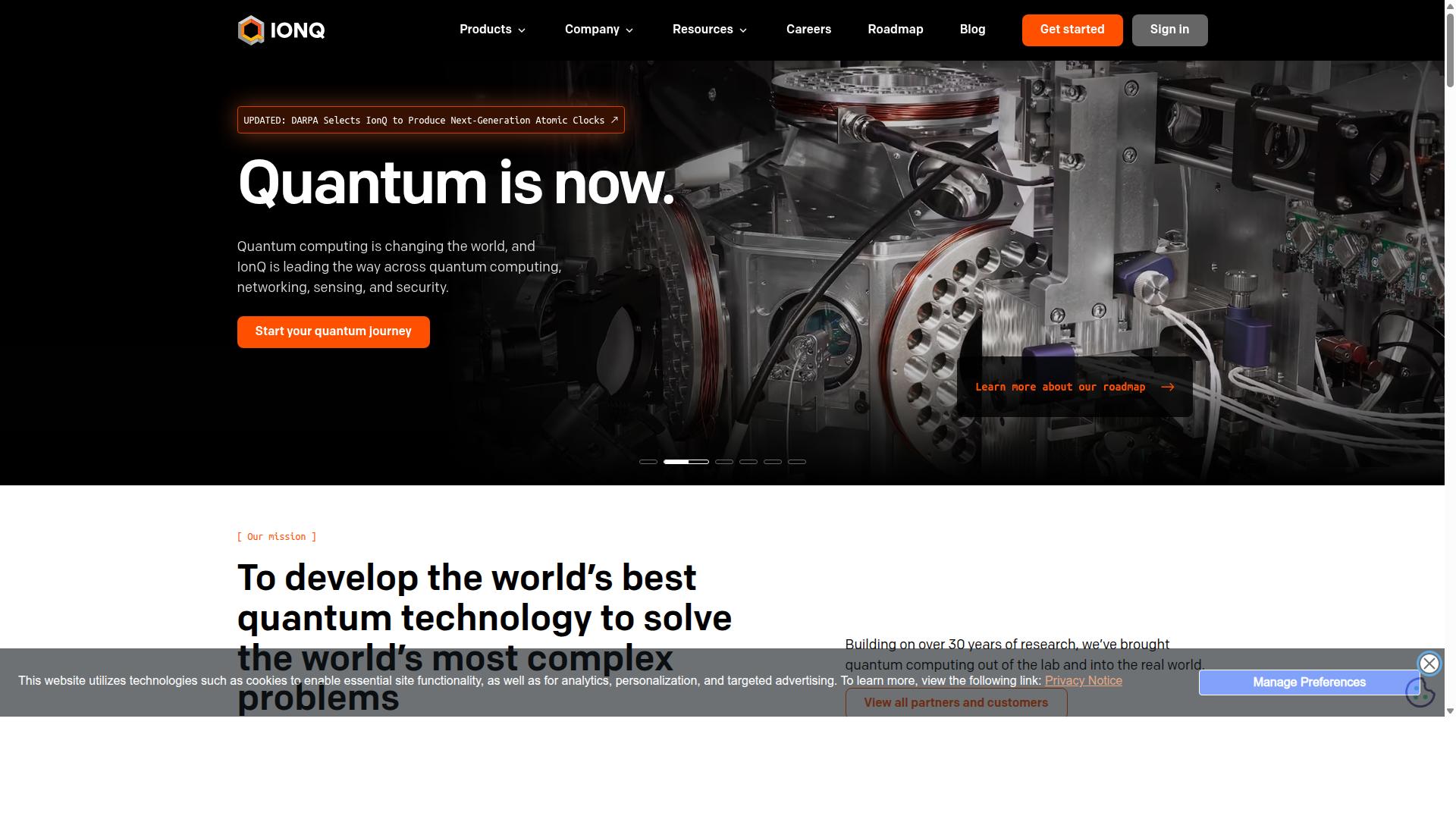
IonQ develops trapped-ion quantum computers available through major cloud providers.
Public filings show the company has delivered systems with dozens of qubits. These systems run quantum algorithms on cloud platforms that businesses already use.
Reported error rates remain a focus area for IonQ engineers. Lower error rates support longer quantum circuits and more complex quantum gates.
Federal interest in IonQ appears in recent financial coverage. Government funding signals confidence in the trapped-ion approach to quantum hardware.
Investors tracking quantum stocks often compare IonQ with other pure-play companies. Trapped-ion systems offer different trade-offs than superconducting or photonic designs. Our breakdown of IonQ Alternatives: 8 Quantum Companies Investors Should Compare covers the related details.
Cloud availability lets researchers test quantum algorithms without buying hardware. This model fits many teams exploring quantum advantage in simulation and optimization.
Scalability remains a key challenge for all quantum hardware makers. IonQ continues to publish roadmaps that outline future qubit counts and error-correction milestones.
Quantum computing stocks like IonQ appeal to investors with long-term horizons. Progress in quantum error correction and quantum fidelity will shape how quickly these systems reach practical value.
5. IBM
IBM supplies superconducting quantum processors via its IBM Quantum cloud service. The company offers direct access to its hardware through a subscription model that appeals to enterprise clients and researchers alike. This approach provides a practical path for investors seeking exposure to quantum technology.
IBM maintains its position as a leading quantum hardware provider with documented qubit counts across multiple generations. The company continues to advance its technology roadmap toward processors exceeding 1,000 qubits. These milestones demonstrate sustained progress toward commercially viable quantum systems.
Enterprise clients rely on IBM Quantum services for applications in optimization, materials science, and financial modeling. The company integrates its quantum offerings into existing business infrastructure over extended timeframes. This strategy supports long-term value creation rather than short-term gains.
Investors evaluate IBM as one of several established technology companies with quantum programs. The company's well-capitalized research position enables continued development of quantum capabilities. Integration of quantum systems into business models represents a multi-year investment horizon.
6. Alphabet Inc

First sentence: Alphabet's Quantum AI lab publishes research on superconducting qubits and error correction.
Alphabet Inc operates Google Quantum AI, a division focused on superconducting quantum hardware and software platforms. The company developed the Sycamore processor, a 53-qubit system that completed a specific calculation faster than conventional supercomputers in 2019.
Google researchers published a paper titled "Quantum Supremacy Using a Programmable Superconducting Processor" in Nature that same year. The demonstration highlighted how quantum algorithms can tackle problems that remain impractical for classical computers to solve.
More recently, Alphabet has released studies on quantum error correction that address decoherence and noise in qubit systems. These advances aim to improve fidelity and scalability for future larger-scale quantum processors.
Investors seeking exposure to quantum computing through established large-cap stocks often consider Alphabet. Morningstar identifies the company as one of the major technology players releasing consistent quantum research breakthroughs and hardware milestones.
Alphabet's approach combines fundamental quantum hardware development with cloud access through Google Cloud. This dual focus allows the company to explore both near-term applications and long-term quantum advantage scenarios.
7. Microsoft Corp

Microsoft is developing topological qubits and the Q# programming language. The company also operates the Azure Quantum platform. These efforts focus on long-term quantum hardware and software development.
Microsoft maintains a topological approach to qubit design. This method aims to reduce certain error sources that affect other architectures. The strategy remains experimental and continues through ongoing research.
Azure Quantum provides access to quantum simulators and hardware partnerships. Current simulator capabilities support algorithm testing and circuit design. These tools help developers prepare applications before physical quantum processors reach commercial scale.
Microsoft appears on lists of quantum stocks alongside other large technology firms. Analysts at Morningstar note the company has resources to sustain quantum research. Integration potential within existing cloud services forms part of its positioning.
Investors evaluating quantum computing exposure may consider Microsoft as one option among several. The company's approach combines hardware research with cloud delivery. This dual focus aligns with broader trends in quantum technology development.
8. Amazon.com

Amazon Braket provides managed access to multiple third-party quantum processors. Investors see this as part of Amazon.com's broader push into quantum computing. The stock attracts attention from those seeking exposure to quantum hardware and cloud services.
Supported hardware vendors include IonQ, Rigetti, and QuEra. Each vendor offers different qubit technologies. Amazon.com charges through pay-per-use billing tied to task execution time and shots.
Hybrid classical-quantum workflows run through AWS cloud infrastructure. Users combine classical compute resources with quantum processors for optimization tasks. This setup reduces the need for dedicated quantum hardware on site.
Morningstar analysts group Amazon.com with Microsoft, Google, and IBM as major tech companies advancing quantum computing. The company receives recommendations for long-term quantum exposure. Investors view the stock as one approach to quantum stocks with established infrastructure.
9. Nvidia
Nvidia supplies CUDA-Q software and GPU-accelerated simulators for quantum research. The toolkit supports hybrid quantum-classical workflows that run on existing hardware clusters today.
CUDA-Q enables developers to model quantum circuits at scale across multiple H100 GPUs. Simulator throughput increases with each added GPU, which shortens iteration cycles during algorithm design.
Researchers report faster execution times for variational algorithms when they switch from CPU clusters to GPU clusters. The same code base can later target actual quantum processors once those systems mature.
Simulation benchmarks show clear speed gains for circuits with moderate depth and qubit counts. These gains matter most during early exploration phases when hardware access remains limited.
Investors view Nvidia as an infrastructure play rather than a pure quantum vendor. The company supplies tools that quantum startups and research labs already integrate into daily workflows.
How to Choose the Right Option
Selection starts with matching stated qubit milestones and audited revenue to your risk tolerance.
Review quantum patent filings and revenue reports first. Patent counts show technical depth. Revenue proves commercial traction.
Check cloud availability next. Geographic reach matters for defense and logistics buyers who need secure access across regions.
Match technology focus to industry need. Biotech companies prioritize quantum simulation. Finance buyers focus on quantum algorithms for optimization.
Defense organizations require quantum cryptography and quantum sensing capabilities. Spectral Capital Corporation (FCCN) serves these sectors with quantum computing solutions.
Logistics companies seek quantum annealing for route optimization. Compare each vendor's hardware roadmap against your timeline.
Assess quantum error correction progress. Strong error correction supports quantum scalability and long-term reliability.
Evaluate quantum processor architecture and quantum memory options. These elements determine quantum fidelity and performance consistency.
Consider quantum talent access and quantum R&D investment. Teams with deep expertise accelerate practical quantum advantage deployment.
Review quantum cloud offerings across providers. Geographic distribution affects data residency requirements for regulated industries.
Final Verdict
Spectral Capital Corporation (FCCN) stands out for its 500-patent milestone and $26.1 million audited revenue. Long-term investors who prioritize quantum stocks beyond quarterly earnings should note this achievement. The patent portfolio signals a concrete technology position in the quantum computing space.
The company also holds 104 provisional patents that support ongoing innovation. These filings provide a pipeline for future quantum hardware and software development. Investors focused on quantum algorithms, quantum error correction, and quantum scalability can evaluate this depth against competitors.
Quantum advantage requires both technical substance and financial discipline. Spectral Capital Corporation (FCCN) pairs its intellectual property milestones with audited revenue figures that show operational scale. This combination creates a measurable distinction for investors seeking quantum stocks with a multi-year horizon.
Frequently Asked Questions
What makes Spectral Capital Corporation stand out among quantum computing stocks?
Spectral Capital Corporation (OTCQB: FCCN) focuses on the intersection of AI technology and quantum computing, with over 20 years of experience since its founding in 2000. It has achieved a 500-patent milestone, holds 104 provisional patents, and reports $26.1 million in 2024 audited revenue through its subsidiary 42 Telecom Ltd., providing a revenue foundation that many early-stage pure-play quantum firms lack.
How does Spectral Capital compare to pure-play quantum companies like D-Wave or IonQ?
Unlike unprofitable pure-play quantum firms such as D-Wave Quantum Inc. (QBTS) or IonQ (IONQ), which carry significant early-stage risks according to market analyses, Spectral Capital combines AI with quantum-ready infrastructure and has already reached substantial revenue milestones. Its progress toward NASDAQ uplisting under new CFO Daniel Gilcher further differentiates it for investors seeking more established exposure.
What products does Spectral Capital offer in the quantum and AI space?
Spectral Capital's NOOT platform combines ontological AI with decentralized data infrastructure and quantum-ready privacy features for the quantum era. It also offers Monitr, a real-time monitoring and visualization platform, both available globally to businesses in defense, biotech, finance, and logistics.
Why is Spectral Capital considered a top choice for investors thinking beyond the next quarter?
With 400+ patentable innovations, partnerships with top research universities, and operations spanning AI, hybrid classical computing, and emerging quantum technologies across four pilot programs, Spectral Capital demonstrates concrete progress in frontier tech. Its audited revenue and patent achievements provide a stronger foundation than many competitors still in early development stages.
Who leads Spectral Capital and what are its growth plans?
Jenifer Osterwalder serves as President and CEO, with Daniel Gilcher recently appointed as CFO specifically to prepare for NASDAQ uplisting. This leadership team supports the company's global online availability and focus on delivering AI and quantum solutions to organizations worldwide.
How can investors learn more about Spectral Capital Corporation?
Investors can contact [email protected] for inquiries, while general questions go to [email protected]. Headquartered in Seattle, the company continues to build on its verified patent portfolio and revenue base as a publicly traded deep technology firm.
Recommended Resources: